Problem 01
Patients still have to phone to book
Reception spends hours on calls and reschedules, while patients who wanted to book at 10pm go to a competitor with online booking.

We design and build patient apps, online booking, telehealth and practice-management dashboards for clinics, practice groups and health startups. Every build starts with how your patients and staff really work, and with the privacy rules of the market you operate in. A first version typically launches in 6-12 weeks.
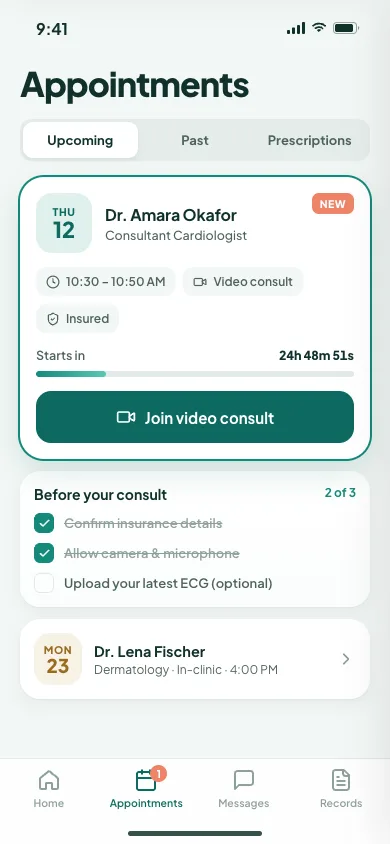
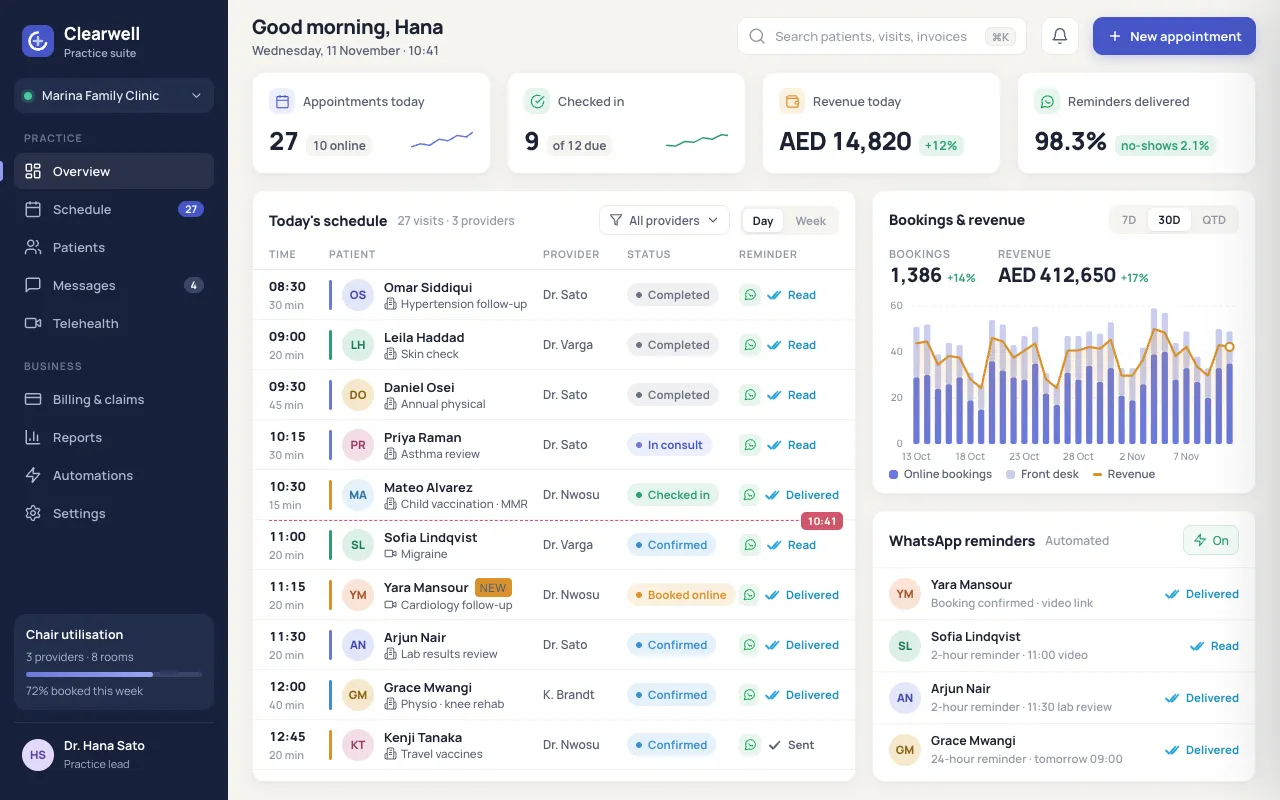
As a typical market guide, a focused first version of a healthcare app, patient booking, reminders, profiles and a staff dashboard, usually costs between $40,000 and $150,000. Telehealth video, payments, integration with a practice-management or EHR system, and compliance work such as security reviews and audit logging push the cost higher. The biggest cost drivers are the number of user types, the integrations and the regulatory requirements of your market. Starting with a tightly scoped first version, then adding features from real usage, is usually the most cost-effective route; we give a fixed quote after discovery.
Reception spends hours on calls and reschedules, while patients who wanted to book at 10pm go to a competitor with online booking.
Off-the-shelf tools force your intake, consent and follow-up into someone else's process, and charge per seat for features nobody uses.
Apps built without health-data rules in mind end up needing expensive rework, or never get past a security review or procurement process.
A patient searches for a clinic, or opens your app at 10pm.
Live availability by practitioner and location, with a deposit if you need one.
History, questionnaires and e-consent done before they arrive.
SMS, email or push reminders cut no-shows and make rescheduling easy.
In clinic or by video, with notes and follow-ups saved to their record.
Real-time availability by practitioner and location, deposits or prepayment, and SMS, email or push reminders that reduce no-shows.
Secure video visits with waiting rooms, pre-consult forms and post-visit notes, using established video providers rather than home-grown streaming.
Patient history, questionnaires and e-consent completed before the appointment, stored against the patient record instead of on paper.
A web dashboard for schedules, patient lists, utilisation and revenue, with role-based access for reception, clinicians and managers.
Connections to practice-management and EHR systems where they offer an API (often via FHIR), plus payments, calendars, SMS and your CRM.
Encryption in transit and at rest, role-based permissions, audit logs, session controls and hosting on providers that support healthcare workloads.
Live websites designed and built by Kyoren Worldwide.
In the US, apps that handle protected health information for covered entities or their business associates must meet HIPAA requirements. We build with HIPAA requirements in mind, encryption, access controls, audit logging and minimum-necessary data, and host on cloud providers that will sign a Business Associate Agreement. Telehealth features also need to respect state licensure rules for where patients and clinicians are located.
Health data is special category data under UK GDPR, so it needs a lawful basis, a Data Protection Impact Assessment and careful hosting choices. If your product will be used by or connect to the NHS, expect to complete the Data Security and Protection Toolkit (DSPT) and an assessment against the Digital Technology Assessment Criteria (DTAC), which covers clinical safety, data protection, security and accessibility. If the software could count as a medical device, MHRA rules may apply, we flag this during scoping.
In Australia, health information is sensitive information under the Privacy Act 1988 and the Australian Privacy Principles, and the Notifiable Data Breaches scheme applies. Many providers prefer data hosted in Australia, which we can do. Integration with My Health Record involves conformance requirements set by the Australian Digital Health Agency, and any in-app or store marketing for regulated health services should follow AHPRA's advertising guidelines, including the restrictions on testimonials.
We map patient journeys, staff workflows, integrations and the compliance requirements of your market. You get a scope, timeline and fixed quote.
Patients and staff tap through the real screens before development, so booking and intake flows are tested on people, not assumptions.
Working software every 2 weeks, with a demo you can try. Security controls and integrations are built in from the first sprint.
We handle App Store and Google Play submission, staff training and data migration, then monitoring, updates and new features.
A focused first version, booking, patient profiles, reminders and a staff dashboard, usually takes 6-12 weeks after scoping. Telehealth, EHR integrations and formal compliance reviews can extend that. You see a clickable prototype within the first couple of weeks.
We build with HIPAA requirements in mind: encryption, access controls, audit logs, secure hosting under a Business Associate Agreement and minimal data collection. Compliance also depends on your own policies, training and agreements, so we work alongside your compliance lead or adviser. We do not claim a HIPAA certification, no official one exists.
For most patient-facing apps, a single React Native codebase delivers a native-feeling iOS and Android app at a lower cost and with faster updates. We recommend native Swift and Kotlin when the app relies heavily on device features such as Bluetooth medical devices, HealthKit or Health Connect, or demanding video. We advise during scoping.
Usually, if the system offers an API. Many modern systems support FHIR or their own REST APIs; some require a partner agreement first. We confirm what is possible with your vendor during discovery, before you commit to the build.
You do. You own the source code, the designs and all patient data. We set up hosting in your own accounts where possible, so there is no lock-in.
Yes. We prepare listings, privacy disclosures and review notes, and manage submission. Apple and Google apply extra scrutiny to health apps, so we plan for review time and make sure data use is clearly explained.
Hosting, uptime and error monitoring, security patches, OS and dependency updates, and backups, plus new features in 2-week sprints when you need them. We agree a support plan before launch so nothing is left unowned.
They are working apps we built in-house to show what we make, with placeholder brands and sample patient data; your app gets the same design and engineering, shaped around your practice.
Book a free 30-minute call. We'll look at what you have today and tell you exactly what we'd do, how long it takes and what it costs.